Table of Content
Finally, there are certain nerve gliding exercises that may help your nerve slide through the cubital tunnel so that symptoms can improve or resolve completely. These special exercises help keep the wrist and forearm from getting stiff and sore. The goal of cubital tunnel syndrome treatment is to reduce compression on the ulnar nerve before muscle tone in the forearm or hand is lost.
Keeping your elbow straight is the main way to treat cubital tunnel syndrome. You may need to speak with an ergonomics expert or physical therapist to figure out ways to modify your daily activities if you have to keep your elbow bent normally. Your doctor may fit you with a brace or splint to keep your arm straight at night. Although the symptoms can sometimes mimic other conditions such as osteoarthritis, rheumatoid arthritis. But depending upon the duration and progression of the disorder, the primary symptom of cubital tunnel syndrome is an aching in the forearm.
Chiropractic Therapy for Cubital Tunnel Syndrome
If you think that you may have cubital tunnel syndrome, see your doctor. Your doctor will perform a physical exam and may order nerve conduction studies to identify where the nerve is being compressed. X-rays may be taken to detect visible causes of compression, such as bone spurs or elbow arthritis.

With proper treatment, you may be able to recover completely. These imaging tests can help your doctor diagnose ulnar tunnel syndrome and rule out the possibility of another medical problem causing your symptoms. Ulnar tunnel syndrome can also be caused by repetitive trauma or pressure to the hand. Participating in certain exercise activities, such as cycling and weightlifting, can create this type of pressure. Some jobs that require using tools that vibrate can also lead to ulnar tunnel syndrome.
Home Treatments for Cubital Tunnel Syndrome
Some people develop cubital tunnel syndrome because of a familial tendency. Diabetes mellitus, Rheumatoid arthritis, and Hypothyroidism also raise the risk of developing cubital tunnel syndrome. Location – Sometimes, the ulnar nerve does not stay in its place and can snap back and forth over the bone with the movement of the elbow. Repeated snapping of the nerve can irritate the nerve. Overstretching – Keeping the elbow bent for a long time can stretch the nerve.

When it enters your hand, it goes through another tunnel called Guyon's canal. Often surgery for cubital tunnel syndrome can be performed with anesthesia that numbs up your arm and does not require full general anesthesia. After surgery, most patients will have some soreness in their elbow, but can go home the same day. Does take somewhere around two to six weeks with usually some hand therapy to help getting motion back for patients to feel like they’re getting back to normal. In the long run, mild symptoms should recover fully, whereas severe symptoms may take longer or may not get back to 100%.
What Causes Cubital Tunnel Syndrome?
This nerve provides sensation to the forearm, as well as to the ring and little fingers. Cubital tunnel syndrome is a problem with the ulnar nerve, which passes through the inside of the elbow. It causes pain that feels a lot like the pain you feel when you hit the "funny bone" in your elbow. If the orthopedic specialist suspects you have cubital tunnel syndrome, he may order special X-rays to see if bony deformities are the cause of the problem. Additionally, he may order electrical nerve conduction studies to determine how well your ulnar nerve is working and to identify exactly where the compression site is located.

Kalmia is a remedy prepared from the evergreen shrub of Mountain Laurel of the family Ericaceae. The main action of the remedy revolves around various conditions causing neuralgia and inflammations. It is also a good remedy in the treatment of sciatica. The pain in the nerve can be sticking, darting, pressing or shooting in nature, attended by numbness of affected part. Pains are intense and can change places with redness and swelling which is worse from least movement.
What happens if cubital tunnel syndrome goes untreated?
We have very little padding in this area of our arm to protect the nerve from rubbing against the bone or other anatomical structures. Repeatedly stretching the ulnar nerve also can cause it to become compressed and inflamed. In fact, people who lean on their elbow repeatedly or whose jobs involve repetitive bending of the elbow are at higher risk for developing cubital tunnel syndrome.
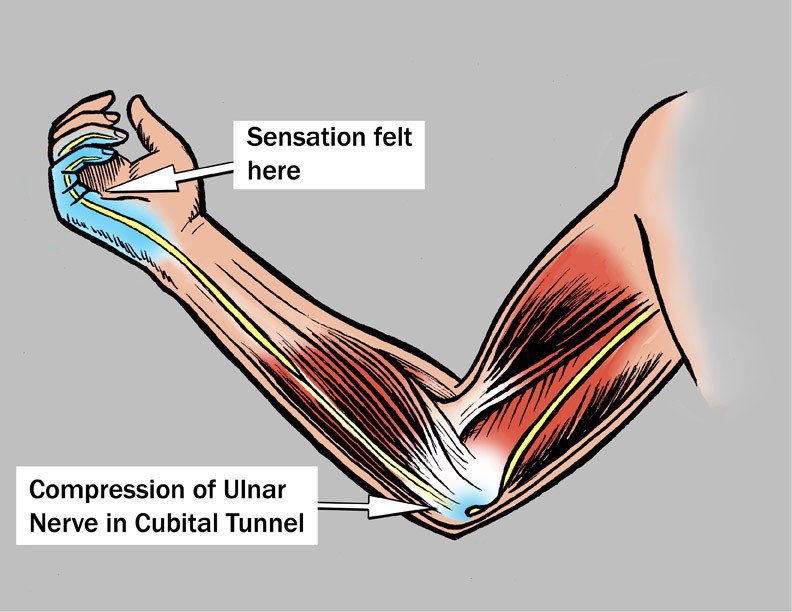
So nerve symptoms usually consist of a burning or electrical type pain and may cause numbness or tingling in the hand. Electromyogram .This test checks nerve and muscle function and may be used to test the forearm muscles controlled by the ulnar nerve. If the muscles do not work the way they should, it may be a sign that there is a problem with the ulnar nerve.
The content is not intended to be a substitute for professional medical advice, diagnosis, or treatment. For professional medical advice, diagnosis, or treatment. This condition may also be treated naturally through massage therapy and exercises. You can also give the natural remedies listed below a shot to manage the symptoms of cubital tunnel syndrome. Effective remedies to try if you put extra pressure on your funny bone nerve unknowingly. Outcomes of rigid night splinting and activity modification in the treatment of cubital tunnel syndrome.
As a Physical Therapist, I knew my ulnar nerve was probably involved. When the ulnar nerve is compressed or irritated, we call this cubital tunnel syndrome or simply ulnar nerve entrapment. Ulnar tunnel syndrome is a condition that affects the wrist. It happens when the ulnar nerve is compressed going from the wrist into the hand through a space referred to as Guyon’s canal.
Secondary symptoms are usually the result of an injury. It can although rarely be caused by intraneural masses like a lipoma or ganglion. However, if you have undergone surgery, activity will be significantly limited for up to six weeks after. Work duties should be modified to accommodate this rest period and driving should be avoided when possible. Difficulty moving your fingers when they’re numb or tingling .

Avoid leaning on your elbows on a regular basis, since this is a known cause of compression of the ulnar nerve. While that is possible, you could also be feeling symptoms of cubital tunnel syndrome. Doctors may also recommend some range-of-motion exercises for people recovering from cubital tunnel syndrome surgery. Cubital tunnel syndrome is a pinching of the large never that goes behind your elbow. So, people often think of it as your funny bone nerve. Wear a protective pad on the elbow to minimize pressure on the ulnar nerve.




No comments:
Post a Comment